| 1F |
Seat reservation |
Issuing of ticket |
| 2F |
Test data management |
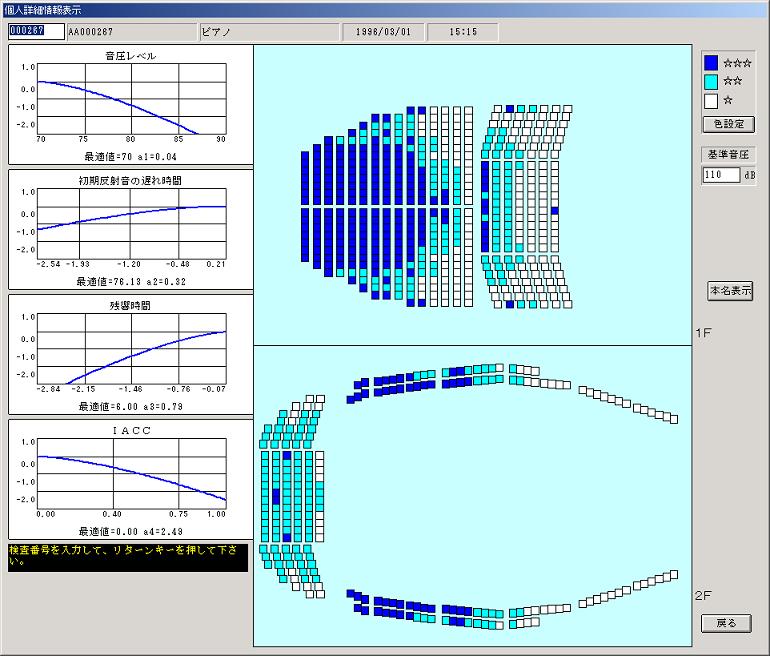
Management of the subjects data, printing of a seating map, issuing
of ID card |
| 2F |
Test operation |
DSP control for sound simulation |
| 2F |
Acoustic CAD system |
Calculation of sound qualities in each seat |
| 2F |
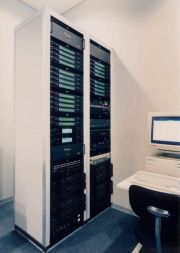
Server |
Data storage |
|
Comments by Hiroshi Setoguchi, Sound coordinator of Miyama
Conceru
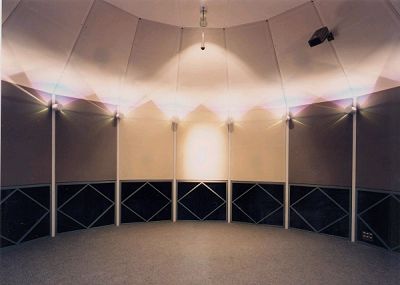
 In Miyama Conceru, it is a great feature that favorite seat can be reserved by
sound preference test in a sound simulation room. Subjective sound preference of
people is tested for several sound qualities in the sound simulation room. The
best conditions for each person is compared with the sound qualities of each
seat in the hall and the best matched seat is found. The seat can be reserved at
the time.
In Miyama Conceru, it is a great feature that favorite seat can be reserved by
sound preference test in a sound simulation room. Subjective sound preference of
people is tested for several sound qualities in the sound simulation room. The
best conditions for each person is compared with the sound qualities of each
seat in the hall and the best matched seat is found. The seat can be reserved at
the time.
It was very grateful that the sound simulation system is designed not only for
reproducing a sound but also for supporting musicians' skill. Musicians perform
considering how audience hears their performance. For example, the musicians
change their singing method and performing method by the hall, because sound
qualities are different by the halls. It is also important for musicians to
correct the defect of their performance in which the music is not audible well
to the audience even when the musicians themselves hear it well. Thanks to a
sound simulation, musicians now can practice the optimal performing method for
every hall.
I asked some major audio equipment makers to construct a system. However, they
were impossible. >Only Yoshimasa gave me a concrete proposal. There was still
newer proposals from Yoshimasa in the midst of the discussion with Professor
Ando (the acoustical designer of Miyama Conceru). While realizing it as a
system, reliability increased further.
Specialists of music use a system. They are not the specialist of computer. A
simple mechanism is the best. I appreciate that I can treat this system without
considering difficult things.
|